
Neurodivergent clients are not a single sensory group. One person may find tactile pulses regulating and visual movement exhausting; another may prefer a lightbar and dislike anything held in the hands. Some people want a detailed explanation before trying equipment, while others understand it best through a brief demonstration.
The clinically useful starting point is therefore not “Which modality works for autism or ADHD?” It is “What helps this client understand, choose and remain able to communicate during the session?”
Do not turn a diagnosis into an equipment setting
Autistic people and people with ADHD may experience sensory and communication differences, but those differences vary substantially between individuals and situations. A diagnosis does not tell the practitioner whether a client will prefer visual, tactile or auditory bilateral stimulation—or whether equipment is appropriate at all.
Autism CRC’s review of healthcare access for autistic adults identifies sensory differences, anxiety, communication barriers and previous healthcare experiences as factors that can affect engagement. It recommends communication accommodations, greater provider knowledge and more accessible environments. These principles support an individual conversation rather than a standard “neurodivergent setup.”
Ask about the sensory system directly
A short sensory discussion can be more useful than guessing from appearance or diagnosis. Questions might include:
- Are moving lights, particular colours or changes in brightness tiring or uncomfortable?
- Are headphones, alternating sounds or pressure around the ears difficult?
- How does the client generally experience vibration, touch or holding objects?
- Do they notice discomfort immediately, or only after it has accumulated?
- Does competing sensory input make communication harder?
- What helps them signal that something needs to change?
These questions should remain invitations, not a diagnostic checklist. Sensory tolerance can also change with fatigue, stress, pain, medication, environment and the demands of the target material.
Explain the equipment concretely
Abstract reassurance such as “It’s gentle” may not provide enough information. A clearer explanation describes what the equipment will do, what the client might notice, how long a short test will last and how it will stop.
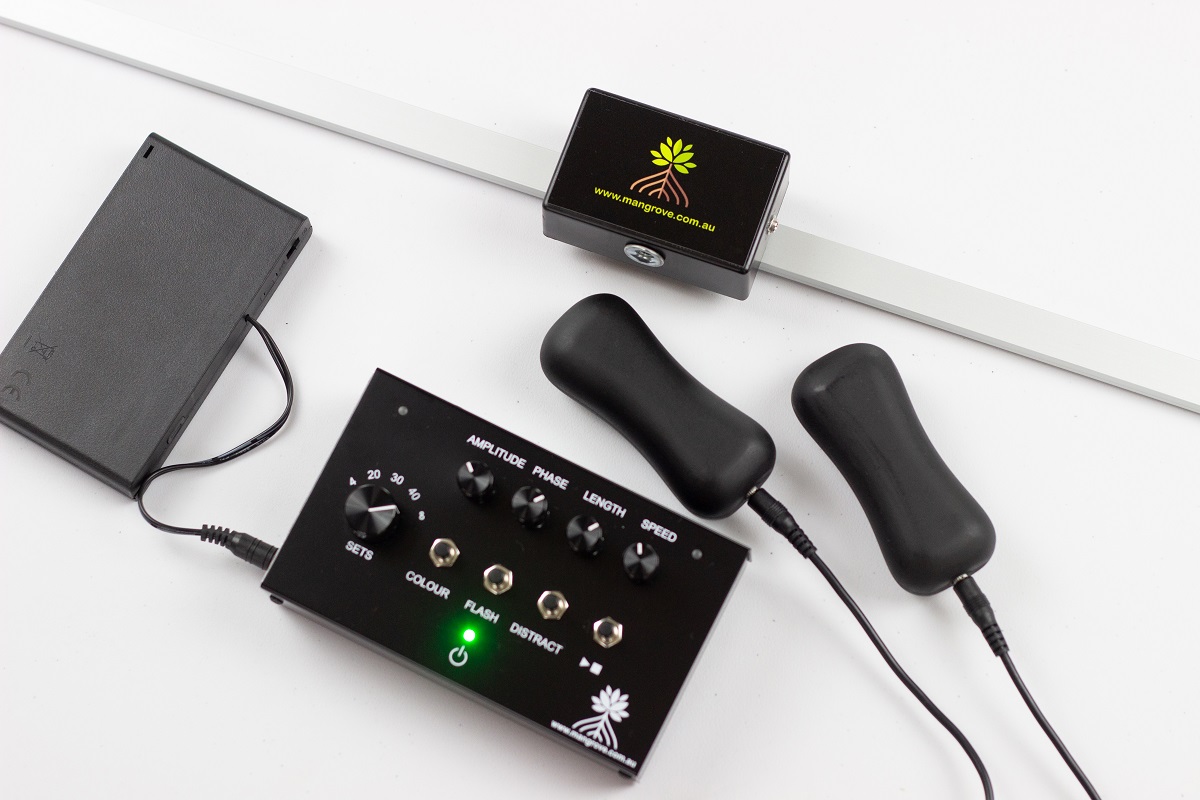
For example: “These two handheld units alternate left and right. We can begin at a low level for a few seconds while you attend to something neutral. You can ask me to stop, put them down or use the agreed signal at any time.”
The Australian Commission on Safety and Quality in Health Care recommends accessible, relevant information and communication tailored to a person’s needs, including neurodiversity. Some clients may prefer written steps, a visual sequence, extra processing time or a demonstration without simultaneous verbal explanation.
Offer a small menu, not every option at once
Choice supports autonomy, but too many choices presented rapidly can increase cognitive load. The practitioner can describe the available modalities briefly, identify any obvious exclusions from the client’s history and test one reasonable option at a time.
A neutral demonstration helps separate the sensory experience from trauma processing. It can answer practical questions: Is the alternation perceptible? Is the visual path comfortable? Do the headphones create pressure? Does holding a tapper compete with the client’s preferred form of movement or self-regulation?
Make the stop signal accessible
A stop signal is only useful if the client can produce it reliably under load and the practitioner can recognise it. A raised hand may work well for one person and poorly for another. Alternatives may include putting down a tapper, turning a palm over, saying a specific word, pressing an agreed control where appropriate, or using another clear movement.
Do not rely exclusively on eye contact, facial expression or conventional body language to judge comfort or agreement. Research with autistic adults in healthcare settings has found that clinicians may misread nonverbal communication when they apply neurotypical expectations. Confirm experience directly and give the client time to answer.
Stillness is not necessarily comfort
A client who becomes quiet, still or compliant may be concentrating, processing language, masking discomfort, freezing or simply preferring not to speak. The practitioner should not treat the absence of objection as proof that the setting is comfortable or that consent remains unchanged.
Useful check-ins can be specific and low-demand: “Is the light comfortable, uncomfortable or hard to tell?” “Would you like the tap to stay the same, become gentler or stop?” Where verbal responding itself adds load, agree beforehand on simple alternatives.
Consider the whole sensory environment
The equipment is only one part of the room. Fluorescent lighting, background conversation, air-conditioning noise, chair texture, fragrance, visual clutter and the pressure of headphones can combine. A tolerable modality in a quiet demonstration may feel different once target work and other sensory demands are added.
Reasonable environmental adjustments might include reducing unnecessary lighting, closing a door, removing background audio, changing chair position or allowing a familiar self-regulation strategy that does not interfere with the clinical task. The aim is not a universally “sensory-free” room, but a workable environment for this person.
Preserve the protocol while adapting access
EMDR-specific research involving autistic and ADHD clients is growing but remains limited. EMDRIA practitioner material recommends a neurodiversity-affirming approach in which clinicians retain the overall EMDR framework while making accommodations for communication, sensory processing and access as needed.
Equipment adaptation should not become improvised treatment outside the practitioner’s training. Changes to explanation, pacing, modality, room setup and response format can support access; decisions about readiness, targeting, reprocessing and closure remain clinical decisions requiring appropriate training, assessment and consultation.
A practical introduction sequence
- Ask about preferences. Explore communication and sensory needs without assuming them from diagnosis.
- Explain concretely. Describe what the modality does, what the client controls and how it stops.
- Choose one option. Avoid presenting every setting and modality simultaneously.
- Demonstrate with neutral attention. Keep the first test brief and separate from target processing.
- Confirm an accessible stop signal. Practise it and show that it produces an immediate stop.
- Invite specific feedback. Offer clear choices without forcing a rapid verbal explanation.
- Recheck during the session. Sensory capacity and communication can change under emotional load.
- Record useful preferences. Document accommodations that support continuity without reducing the client to a fixed sensory profile.
Individualisation is the point
A neurodiversity-affirming equipment introduction is not a special collection of settings. It is a process of asking, demonstrating, listening and adapting. The client does not need to appear comfortable in a conventional way; they need a credible way to communicate what works, what does not and when something should stop.
This article is general educational information for EMDR-trained practitioners. It is not a substitute for accredited training, supervision, individual assessment, disability-access obligations or consultation with appropriately qualified professionals.
Sources
- EMDR International Association: Finding the Magic in the Neurotype—Using EMDR With Neurodivergent Clients
- Australian Commission on Safety and Quality in Health Care: Informed consent
- Australian Commission: Communicating for safety
- Autism CRC: Supporting the healthcare needs of autistic adults
- Sensory overload and communication barriers reported by autistic adults in healthcare settings