
When several clinicians share one EMDR system, the equipment moves from being an individual tool to a small piece of clinical infrastructure. That creates practical questions that do not arise when one practitioner controls the setup: Who checks it? Who cleans it? Where are the components stored? What happens when a cable or tapper behaves differently? And how are client preferences communicated without turning yesterday’s settings into today’s prescription?
A simple group-practice plan can reduce uncertainty while keeping the clinical decisions with each appropriately trained practitioner.
Shared equipment does not mean shared clinical responsibility
Each clinician remains responsible for determining whether EMDR is appropriate for the client, which phase of treatment they are undertaking and whether a particular form of bilateral stimulation is clinically suitable. Familiarity with the controller is not a substitute for EMDR training.
EMDRIA describes EMDR as a clinician-led psychotherapy and its approved basic-training framework includes instruction, supervised practicum and consultation. A group practice should therefore distinguish clearly between permission to access the equipment and competence to use it within EMDR treatment.
Nominate an equipment custodian
Shared responsibility can easily become unclear responsibility. Nominate a person—or a clearly defined rotating role—to oversee the practical condition of the system. This is not a clinical supervisor role. It is an equipment-management function that may include:
- keeping an inventory of the controller, power supply, lightbar, tripod, tappers, headphones and cables;
- recording faults and removing unreliable components from circulation;
- maintaining access to the manufacturer’s instructions and support details;
- checking that cleaning materials are compatible with each component; and
- making sure replacement items are approved for the system.
Standardise the setup—not the treatment
A shared clinic benefits from a consistent physical setup. Labelled cables, a defined storage location and an agreed connection sequence can reduce avoidable errors. A brief visual guide can show where the lightbar, tappers and optional headphones connect to the controller.
What should not be standardised is a single “best” speed, amplitude, travel length or modality for every client. Starting settings may be documented for continuity, but the next practitioner—or the same practitioner at the next appointment—still needs to check comfort, accessibility and clinical suitability.
Create a between-user reset
Before the equipment passes to another clinician, return it to an agreed neutral state. Depending on the system and clinic, this may include stopping the active set, lowering adjustable outputs, disconnecting headphones, visually inspecting cables and returning all components to their labelled positions.
The purpose is not to erase useful clinical information. It is to prevent the next user from assuming that the previous configuration is appropriate or from beginning with an unexpectedly high output.
Use a cleaning process that fits the setting and materials
Tappers, headphones and controls may be handled by different people across the day. The clinic should have a written, risk-based cleaning process consistent with current infection-prevention guidance, organisational policy and the equipment manufacturer’s instructions.
Do not assume that a stronger chemical is automatically safer. Liquids, abrasive products or incompatible disinfectants may damage electronic components or surface finishes. Cleaning responsibilities should be explicit: practitioners need to know what is done between clients, what is done at the end of the day and how to report a component that cannot be cleaned adequately.
Keep a fault log separate from clinical records
If a component is intermittent, label it and remove it from use rather than leaving the next clinician to rediscover the problem during a session. A simple equipment log can record the date, component, observed behaviour, checks performed and resolution.
Avoid putting identifiable client information in the equipment log. The clinical record should document information relevant to that client’s care; the equipment log should contain only what is necessary to identify and resolve the technical issue.
Handover preferences carefully
When care is transferred between practitioners, relevant client preferences may support continuity: for example, that visual tracking caused strain, that the client found tactile input clearer or that an alternative stop signal was required.
Settings can be included when clinically relevant, but they should be treated as historical information rather than instructions. The receiving practitioner needs to make an independent assessment within their professional role, scope, training and therapeutic relationship.
Plan for booking and room changes
A shared system is useful only when it is available, complete and ready. A booking process should allow enough time for setup, cleaning and return—not merely the appointment itself. If the system moves between rooms, consider tripod stability, power access, cable routes, lighting and the clinician’s ability to observe the client each time.
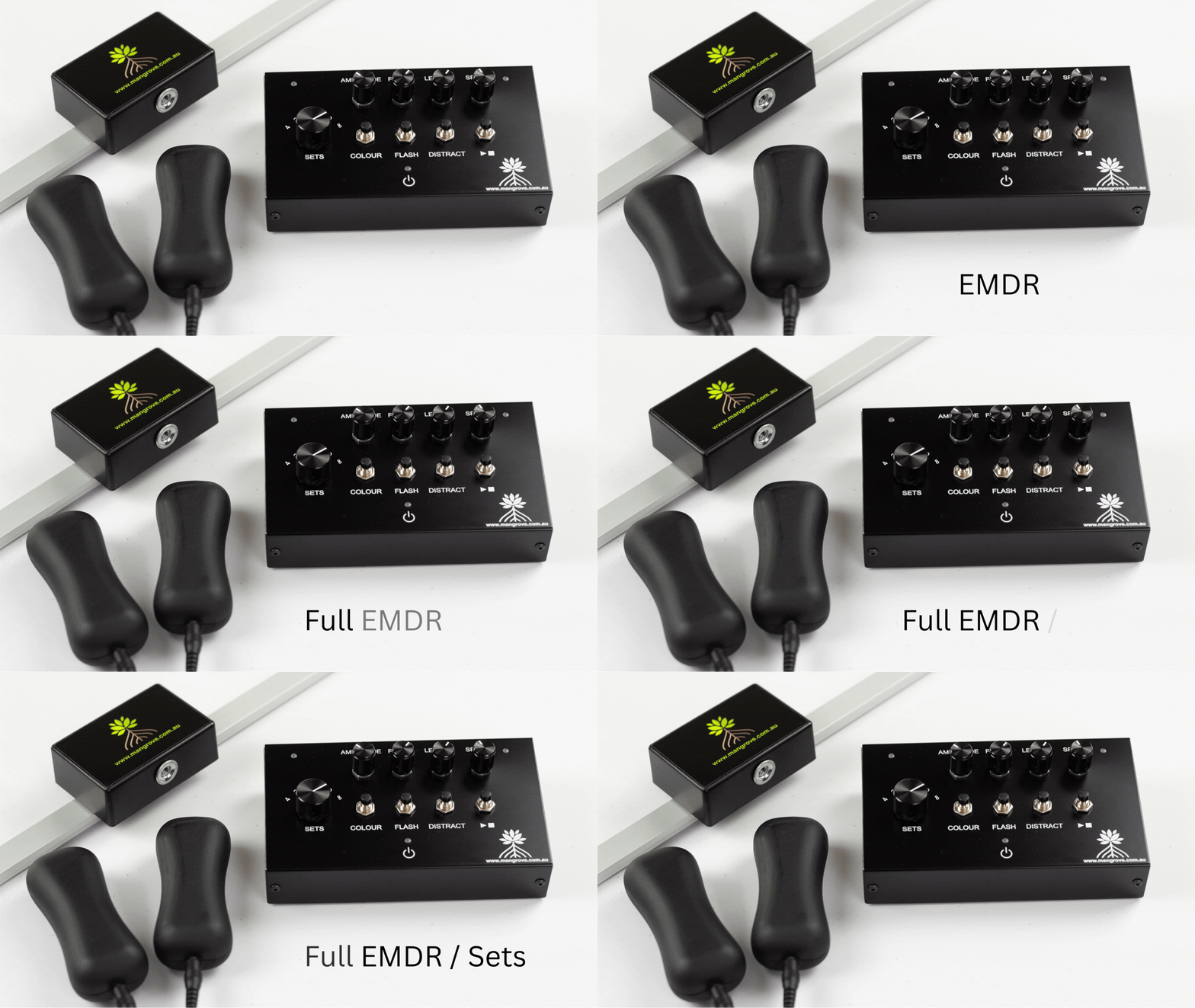
For Mangrove’s Simple EMDR Set, the core arrangement includes a master controller, lightbar, two wired tappers and optional stereo headphone output. Because the components connect physically, an inventory and connection check are particularly helpful when the set is transported or shared.
A practical group-practice checklist
- Identify which appropriately trained clinicians may use the system.
- Nominate responsibility for inventory, faults and manufacturer contact.
- Store components together in labelled locations.
- Use a consistent physical setup and connection sequence.
- Reset adjustable outputs before handover.
- Follow a written, material-compatible cleaning process.
- Remove faulty or unpredictable components from circulation.
- Keep the technical fault log free of identifiable client details.
- Treat previous settings as information, not a standing prescription.
- Allow booking time for setup, cleaning and return.
Shared tools need clear ownership
Group practices do not need a complicated equipment-management system. They do need clarity. When the physical setup, cleaning responsibilities and fault process are predictable, each practitioner can give more attention to the client and the clinical work.
Share the equipment. Standardise its care. Keep treatment decisions individual.
This article provides general educational information for appropriately trained practitioners. It is not a treatment protocol, infection-control procedure or substitute for professional training, manufacturer instructions, organisational policy, supervision or clinical judgement.
Sources
- EMDR International Association: EMDR Basic Training
- EMDR International Association: Definition of EMDR
- Australian Commission on Safety and Quality in Health Care: Australian Guidelines for the Prevention and Control of Infection in Healthcare
- Mangrove Inspired EMDR: Simple EMDR Set Product and Tripod Guide